
27 July 2026 Media Statement: Chief Justice pays tribute to the Rt Hon Sir John Henry KNZM PC KC
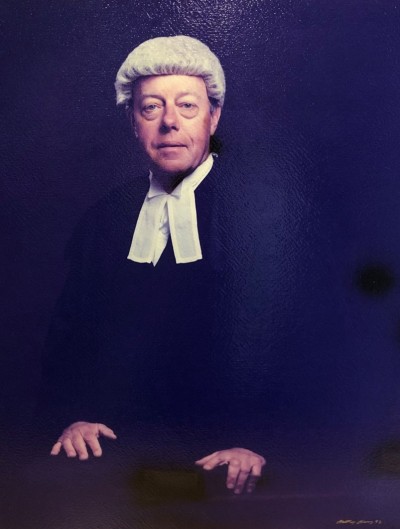
The Rt Hon Sir John Steele Henry KNZM PC KC (1932 – 2026)
The Chief Justice, the Rt Hon Dame Helen Winkelmann, today paid tribute on behalf of New Zealand’s judiciary to the Rt Hon Sir John Steele Henry KNZM PC KC, who passed away on Friday 24 July 2026.
“On behalf of the New Zealand judiciary, I acknowledge Sir John’s service to the judiciary and to New Zealand and extend my deepest sympathy to his family. Sir John’s death causes great sadness within the judiciary and within the legal profession. For counsel, he was the model of a courteous, wise and humane judge. For his colleagues, he set the standard — with outstanding legal ability, and an unfailing commitment to fairness of process and a just outcome. He continues to be a role model for many of today’s judges.”
Sir John had a distinguished career at the bar and was appointed a Queen’s Counsel in 1980. His work at the bar included representing the New Zealand Police in the Royal Commission of Inquiry into the murder convictions of Arthur Allan Thomas, and acting as leading legal counsel for the consortium representing the estates of the deceased passengers in the Royal Commission of Inquiry into the Mount Erebus aircraft disaster.
Sir John was appointed as a Judge of the High Court in 1984, and his judicial career spanned more than two decades. He became a Judge of the Court of Appeal in 1995 and served as a Privy Councillor from 1996.
At the time of Sir John’s statutory retirement in July 2000, then Chief Justice Dame Sian Elias said of him that no judicial office holder in New Zealand was held in higher regard by their colleagues on the bench and in the legal profession. She remarked that this high regard had been earned by the breadth of Sir John’s grasp of legal principle, his incisiveness in analysing complex facts and law, his unfailing courtesy, and his generosity in offering assistance to others.
Sir John’s judicial career continued into the early years of the twenty-first century. As well as serving as an Acting Judge of the then newly established Supreme Court, he served as a Judge of the High Court of the Cook Islands.
Sir John lived a life of service to the law and to his country. Speaking extrajudicially soon after his appointment to the High Court in 1984, he described a commitment to the rule of law as vitally important to society and to its wellbeing.[1] He said that sharing knowledge of and engaging with the law as a matter of common heritage would ensure the greatest contribution to the maintenance of the rule of law. That commitment and those behaviours were in evidence throughout his career.
Sir John is survived by his wife, Lady Jenny Henry, his three children, Vicki, Susan and David, and his grandchildren and great-grandchild.
Biography
Born in Auckland on 3 July 1932 to the Hon Sir Trevor Henry and Lady Audrey Henry, Sir John was a descendant of a family who emigrated to New Zealand in the nineteenth century from Scotland. He began studying law at Auckland University College in 1950. Following completion of his LLB studies, Sir John was admitted to the bar in Auckland in 1955. That milestone was especially significant for his family because his father was appointed to the High Court bench on the same day.[2]
In 1955, Sir John commenced his distinguished legal career as a partner at Wilson Henry Sinclair & Martin. Established by Sir Trevor, the firm was a prominent Auckland legal practice and is the direct predecessor of the law firm known today as Hesketh Henry.
Sir John went to the independent bar in 1980 and was appointed Queen’s Counsel in the same year. Presiding over his call to the inner bar in Auckland on 2 May 1980, Sir Ronald Davison (the then-Chief Justice) remarked that Sir John’s contemporaries had long recognised that he was destined to be a leader of the bar, and that:[3]
When the question of your appointment was referred to me, I had no hesitation in reaching a decision … The approval of all other Judges, too, was immediately forthcoming.
That same year, Sir John appeared as counsel representing the New Zealand Police in the Royal Commission of Inquiry into the murder convictions of Arthur Allan Thomas, and as leading legal counsel for the consortium representing the estates of the deceased passengers in the Royal Commission of Inquiry into the Mount Erebus aircraft disaster.
Sir John was sworn in as a Temporary Judge of the High Court in Auckland on 11 May 1984. As remarked upon by Sir Ronald during the ceremony, the swearing-in marked a national milestone in that it was the first occasion in New Zealand’s history where a judge and their offspring had sat together on the same court bench.[4]
In line with the system that applied at the time, Sir John’s judicial appointment was always intended to be made permanent as soon as a vacancy arose on the High Court bench. As a permanent Judge, he went on to serve as a Commercial List Judge in 1987, and then as Executive Judge of the High Court at Auckland from 1991 to 1994.
Sir John’s appointment occurred shortly before the economic downturn of the late 1980s. The late 1980s and the early part of the next decade were particularly busy for the High Court as the impact of that downturn was worked through before the courts. Sir John sat on many of the cases that shaped the interpretation of then little-tested market regulation legislation such as the Securities Act 1978. His careful but commercially informed analysis of legislation designed to better regulate insolvency situations – such as the Companies Act 1993, the Receivership Act 1993, and the Corporations (Investigation and Management) Act 1989 which created the statutory management regime — continues to shape its interpretation and application today.
On 12 August 1995, Sir John was appointed a permanent member of the Court of Appeal, and he went on to become a Member of the Privy Council from November 1996. He delivered the Privy Council decision in Arklow Investments Ltd v Maclean.[5]
After his retirement from the Court of Appeal in 2000, Sir John was appointed as an Acting Judge of the Supreme Court, serving in that capacity from November 2004 until July 2007. He also served in retirement as a Judge of the High Court of the Cook Islands.
Among his wide-ranging commitments to serving the profession and advancing the administration of justice, Sir John was President of the Medico-Legal Society in 1979, President of the Auckland District Law Society (now the Law Association) from 1979-1980, and Vice-President of the New Zealand Law Society | Te Kāhui Ture o Aotearoa (NZLS) from 1980-1981. His NZLS committee involvements included membership of the Council (1976-81), Executive Committee (1979-81) and Ethics Committee (1977-78). He was a long-serving member of the Contracts and Commercial Law Reform Committee (1969-85) and was also a fellow of the Chartered Institute of Arbitrators and a fellow of the International Academy of Trial Lawyers.
In recognition of his contributions to New Zealand, Sir John was awarded a New Zealand 1990 Commemoration Medal, and he was made a Distinguished Companion of the New Zealand Order of Merit (DCNZM) in the 2001 Queen’s Birthday Honours List for services as a Judge of the Court of Appeal. Following changes to the New Zealand Royal Honours system, he was redesignated a Knight Companion (KNZM) in the Special Honours List issued in August 2009.
[1] John S Henry “Earl F Nelson Memorial Lecture: The Right to Protection Against Self-incrimination” (1986) 51 Missouri Law Review 201 at 202.
[2] At that time, the High Court of New Zealand was known as the Supreme Court.
[3] Sir Ronald Davison “Remarks on calling Mr J. S. Henry to the Inner Bar” (Auckland, 2 May 1980).
[4] While Sir Trevor had retired in 1974, he had continued in judicial office as a member of the Fiji Court of Appeal and was invited by Sir Ronald to sit on the High Court bench for the swearing-in ceremony.
[5] Arklow Investments Ltd v Maclean [2000] 2 NZLR 1 (PC).